 |
L'Eglise Aristotelicienne Romaine The Roman and Aristotelic Church
Forum RP de l'Eglise Aristotelicienne du jeu en ligne RR
Forum RP for the Aristotelic Church of the RK online game
 
|
| Voir le sujet précédent :: Voir le sujet suivant |
| Auteur |
Message |
Ferecide

Inscrit le: 02 Mai 2016
Messages: 190
Localisation: Lodi - Episcopium/ Rome - Villa Lante
|
 Posté le: Mar Jan 20, 2026 7:35 pm Sujet du message: Posté le: Mar Jan 20, 2026 7:35 pm Sujet du message: |
 |
|
Monsignor Ferecide greeted the guests that had taken time off of their busy days to come to the presentation of the new exhibition, and once he finished guiding them to their seats with the help of the Museums' staff he started to speak:
Good morning to you all, and first let me take the time to thank you all for being here: it is an honor for me having you all here together on this joyful day for the Museums and for the entire community of the faithful.
Today we are gathered here to inaugurate this new museum hall and to admire together the hard work carried out by artists and curators to bring to the Church an exhibition that could be both celebratory of the life of the First Prophet and educational for all visitors.
In selecting the works, we sought first and foremost to keep in mind the many students who come to Rome for their studies, seeking to accompany their reading and in-depth study of the Book of Virtues with graphic masterpieces.
Each work has been produced and preserved with the utmost care to ensure that this collection is worthy of the challenging theme selected. You will see works depicting specific scenes from the life of the First Prophet, as well as more symbolic works, but in both cases deeply inspired by the profound faith of those who worked on them.
So allow me to express my heartfelt thanks to those who made this exhibition possible: thanks to all the artists, the curators, and the Congregation that oversees the work of the Museums, in particular its chancellor who guides it.
I will now leave you in the capable hands of the curators, who, with their experience and artistic sensibility, will present the works in the collection to you. I hope you may enjoy this immersive experience.
He then stepped aside, and left the central area to the curators.
_________________
 |
|
| Revenir en haut de page |
|
 |
katnis.

Inscrit le: 15 Juin 2020
Messages: 23
|
| Posté le: Ven Jan 23, 2026 11:54 am Sujet du message: |
|
|
Katherine arrives accompanied by Father Ferecide carrying the first painting
1. "Birth of Aristotle" by Father Julian from Denia
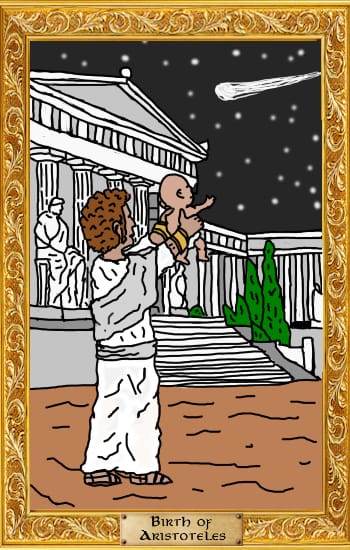
The first painting made by the aristocrat Father Julian da Denia represents the birth is depicted when the father shows him in his arms by raising him.
ITA
Katherine arriva accompagnata da padre Ferecide portando il primo dipinto
Il primo dipinto fatto dall'arista Padre Julian da Denia rappresenta la nascita viene raffigurato quando il padre lo mostra in braccio alzandolo .
_________________

figlia di Callez e Betelgeuse, sorella di Edoard1, Jacklionheart, Margot_isabelle e Sarkhan_ |
|
| Revenir en haut de page |
|
|
Sarkhan_

Inscrit le: 19 Juin 2021
Messages: 18
|
| Posté le: Ven Jan 23, 2026 12:40 pm Sujet du message: |
|
|
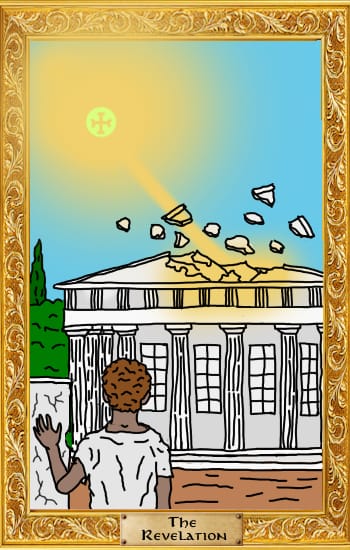
2."The Revelation" by Father Julian
Sarkhan followed his sister and brought the second painting.
The work by the artist Father Julian depicts The Revelation
In which Aristotle receives the Word of the Creator.
One day, the young Aristotle, when he was only five years old, wanted to sit near the temple of the false god Apollo in the city of Stagira.
The child loved to gaze at the tall white stone columns standing out against the blue sky. As he approached the temple steps, he stopped, as if immobilized by an invisible force.
Not understanding what was happening, he turned toward the city to call his mother, Phaestis, who was nearby. But no sound came from his lips.
Ita
Sarkhan seguì la sorella e portò il secondo dipinto
L’opera realizzata dall'Artista Father Julian raffigura La rivelazione
In cui Aristotele riceve il Verbo del Creatore
Un giorno il giovane Aristotele, quando aveva solo cinque anni, volle sedersi presso al tempio del falso dio Apollo nella città di Stagira.
Al bambino piaceva guardare le alte colonne di pietra bianca stagliarsi nell’azzurro del cielo.Mentre si avvicinava ai gradini del tempio si fermò, come immobilizzato da una forza invisibile.
Non comprendendo cosa avveniva, si voltò in direzione della città per chiamare la madre Festide, che si trovava poco lontano. Ma dalle sue labbra non uscì alcun suono.
_________________

Dernière édition par Sarkhan_ le Dim Jan 25, 2026 2:49 pm; édité 1 fois |
|
| Revenir en haut de page |
|
|
katnis.
Inscrit le: 15 Juin 2020
Messages: 23
|
| Posté le: Sam Jan 24, 2026 4:09 pm Sujet du message: |
|
|
3. "The Soul" Mons. Branwyn Von Hohenzollern Habsburg

The spectacle of the soul
The inner revelation
"Know thyself, and thou shalt know the Creator."
(Book of Virtues, Dialogues of Aristotle)
Aristotle sits alone, immersed in divine light.
A ray from above pierces the darkness – a symbol of knowledge
that does not come from man himself, but is bestowed by the Most High.
The book before him represents dogma, the scripture of truth,
while the angels in the golden haze embody divine inspiration.
This scene depicts the silent birth of philosophy in the heart of the prophet:
he recognises that the soul is a divine spark
that returns to the Creator through knowledge and virtue.
Katherine continues with another painting
The work of the artist Monsignor Branwyn Von Hohenzollern Habsburg depicts The Soul
In which Aristotle establishes that man must have a mind, as opposed to animals.
ITA
Katherine prosegue con un altro dipinto
Il lavoro dell'artista Mons. Branwyn Von Hohenzollern Asburgo raffigura L' Anima
In cui Aristotele stabilisce che l’uomo deve avere una mente, al contrario degli animali.
_________________
figlia di Callez e Betelgeuse, sorella di Edoard1, Jacklionheart, Margot_isabelle e Sarkhan_ |
|
| Revenir en haut de page |
|
|
Sarkhan_
Inscrit le: 19 Juin 2021
Messages: 18
|
| Posté le: Sam Jan 24, 2026 7:13 pm Sujet du message: |
|
|
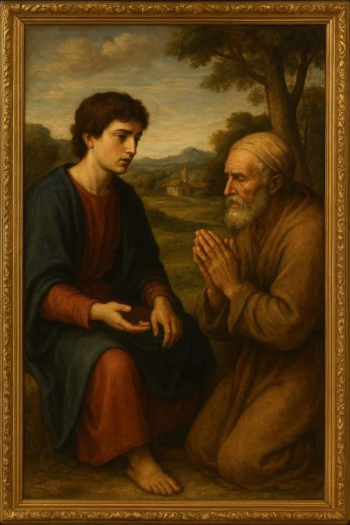
4. Artist Unknown (Tuscan School)
The Wandering Days
The Wandering Days
These unknown artists of the Tuscan school depict Aristotle
at the age of fifteen, lost both his father and mother, and was entrusted to the guardianship of a close relative, Proxenus,
who lived in a remote region between Stagira and Athens. The young orphan was raised to work the land. This condition did not satisfy him at all,
convinced as he was that his mind was more skilled than his hands. He often met humble peasants, with whom Proxenus worked. He certainly admired their love for the simple life.
Ita
I giorni erranti
Questi Artisti sconosciuti della scuola Toscana rappresentano Aristotele
raggiunse l’età di quindici anni, perse sia il padre che la madre, e fu affidato alla tutela di un parente prossimo, Prosseno,
che viveva in una regione remota tra Stagira e Atene. Il giovane orfano era educato al duro lavoro della terra. Questa condizione non lo soddisfaceva affatto,
persuaso com’era che la sua mente fosse più abile delle sua mani. Incontrava spesso umili contadini, coi quali lavorava Prosseno. Ammirava, certo, il loro amore per la vita semplice.
_________________
|
|
| Revenir en haut de page |
|
|
katnis.
Inscrit le: 15 Juin 2020
Messages: 23
|
| Posté le: Dim Jan 25, 2026 1:23 pm Sujet du message: |
|
|
5. Artist S.E. Branwyn von Hohenzollern-Habsburg

"Aristotle teaches the humble"
Knowledge as a divine gift
‘Those who seek wisdom must first learn humility.’
(Book of Virtues, Logion of Aristotle)
Aristotle, the first prophet, teaches the truth of God.
A man kneels before him – a symbol of man who receives knowledge
not through pride, but through humility.
His raised hand is a sign of the divine word,
his gaze rests gently on the learner.
The landscape opens up in peace and harmony,
a sign of the balance of virtues.
Red stands for divine love, blue for heavenly reason.
Those who find the centre recognise the divine mirror within themselves..
Katherine continues with another painting made by the artist H.E. Branwyn von Hohenzollern-Habsburg
In this painting he represents Aristotle, who teaches the humble the truth of God.
ITA
Katherine prosegue con un altro dipinto fatto dall'artista S.E. Branwyn von Hohenzollern-Habsburg
In questo dipinto rappresenta Aristotele, che insegna agli umili la verità di Dio.
_________________
figlia di Callez e Betelgeuse, sorella di Edoard1, Jacklionheart, Margot_isabelle e Sarkhan_
Dernière édition par katnis. le Lun Fév 02, 2026 1:05 pm; édité 1 fois |
|
| Revenir en haut de page |
|
|
Sarkhan_
Inscrit le: 19 Juin 2021
Messages: 18
|
| Posté le: Dim Jan 25, 2026 2:36 pm Sujet du message: |
|
|
6."Aristotle in the Academy of Athens"

The artist Maeli depicts in the painting
Aristotle advancing into the Academy of Athens after his long journey. He wears sober, austere clothing,
reminiscent of a man dedicated to the spiritual life.
His bearing is composed, and his face, serene yet alert, reflects his habit of meditation and inner discipline.
The setting is a grandiose marble building:
colonnades, soaring arches, and solemn statues frame the scene, creating an almost sacred atmosphere.
In the center, Aristotle meets Plato, who observes him with interest as the young man presents a rigorous argument,
composed of clear and compelling logical steps.
The intensity of the hand gestures suggests a syllogism taking shape, so clear that it strikes the master himself.
Around the two, groups of scholars converse lively,
but the light falling on the protagonists isolates the meeting
as a significant moment,
a passage of knowledge and dedication.
The whole creates a scene in which spirituality
and reason intertwine,
showing an Aristotle who brings to the heart of the great Academy an almost monastic rigor combined with a prodigious mind.
Ita.
"Aristotele nell'Accademia di Atene"
L' Artista Maeli rappresenta nel dipinto
Aristotele mentre avanza nell’Accademia di Atene dopo il suo lungo viaggio. Indossa abiti sobri, dalle linee austere,
simili a quelli di un uomo dedito alla vita spirituale.
Il suo portamento è composto, e il volto, sereno ma vigile, riflette la sua abitudine alla meditazione e alla disciplina interiore.
L’ambientazione è un grandioso edificio marmoreo:
colonnati, archi altissimi e statue dall’aspetto solenne incorniciano la scena, creando un’atmosfera quasi sacrale.
Al centro, Aristotele incontra Platone, che lo osserva con interesse mentre il giovane espone un ragionamento rigoroso,
fatto di passaggi logici chiari e stringenti.
L’intensità del gesto delle mani suggerisce un sillogismo che prende forma, così limpido da colpire lo stesso maestro.
Intorno ai due, gruppi di studiosi conversano in toni vivaci,
ma la luce che cade sui protagonisti isola l’incontro
come un momento significativo,
un passaggio di conoscenza e dedizione.
L’insieme restituisce una scena in cui spiritualità
e ragione si intrecciano,
mostrando un Aristotele che porta nel cuore della grande Accademia un rigore quasi monastico unito a una mente prodigiosa.
_________________
|
|
| Revenir en haut de page |
|
|
katnis.
Inscrit le: 15 Juin 2020
Messages: 23
|
| Posté le: Mar Jan 27, 2026 4:52 pm Sujet du message: |
|
|
7. Artist S.E. Branwyn von Hohenzollern-Habsburg

The break with Plato
The beginning of the true path
‘Truth is not in the shadows of ideas,
but in the light of reality.’
(Book of Virtues, dialogue between Aristotle and Plato)
Two teachers stand facing each other – Plato, lost in thought,
and Aristotle, determinedly opening the book of truth.
With a calm but firm gesture, he points to creation itself:
the visible world as the work of the Most High.
The moment of rupture is not a dispute, but a liberation.
Aristotle breaks free from the shadow of thought
to recognise reality as a divine sign.
Thus begins his true path – from thought to revelation.
Katherine continues with another painting made by the artist H.E. Branwyn von Hohenzollern-Habsburg
In this painting he represents Aristotle leaving Plato and continuing his journey.
ITA
Katherine prosegue con un altro dipinto fatto dall'artista S.E. Branwyn von Hohenzollern-Habsburg
In questo dipinto rappresenta Aristotele lascia Platone e prosegue il suo cammino.
_________________
figlia di Callez e Betelgeuse, sorella di Edoard1, Jacklionheart, Margot_isabelle e Sarkhan_
Dernière édition par katnis. le Lun Fév 02, 2026 1:08 pm; édité 1 fois |
|
| Revenir en haut de page |
|
|
Sarkhan_
Inscrit le: 19 Juin 2021
Messages: 18
|
| Posté le: Mar Jan 27, 2026 9:27 pm Sujet du message: |
|
|
8."The Nature of the Stars" - by Wedzimir Lubomirski
Sarkhan brought a new painting
The work by the painter Wedzimir Lubomirski depicts the Prophet Aristotle, a teacher sent by the Almighty to reveal the order of creation to mankind. Around him, his followers listen intently.
The stars are not just points of light, but living signs of the divine presence.
Ita
Sarkhan portò un altro dipinto
L’opera realizzata dal pittore Wedzimir Lubomirski raffigura il Profeta Aristotele, maestro inviato dall’Altissimo per rivelare agli uomini l’ordine del creato.
Attorno a lui, i suoi seguaci lo ascoltano assorti.
Le stelle non sono solo punti di luce, ma segni vivi della presenza divina.
_________________
|
|
| Revenir en haut de page |
|
|
katnis.
Inscrit le: 15 Juin 2020
Messages: 23
|
| Posté le: Mer Jan 28, 2026 9:02 pm Sujet du message: |
|
|
9. Artist Victor Hiroshi. Soga
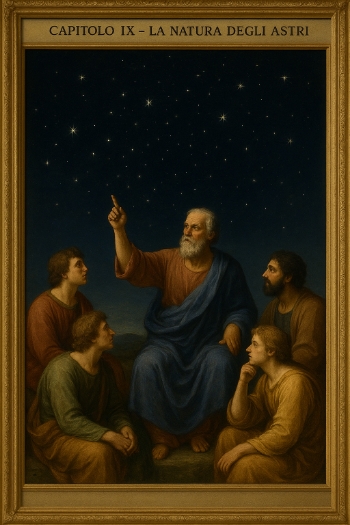
“Chapter IX – The nature of the stars”
The work depicts the Prophet Aristotle, a teacher sent by the Most High to reveal the order of creation to mankind.
He sits among his disciples, enveloped in the silence of the night.
With his finger raised, he points to the firmament, as if to show that every star is a spark of divine will, a fragment of the mind of the Most High.
Around him, his followers listen intently.
The stars are not just points of light, but living signs of the divine presence.
In the Prophet's gesture, knowledge becomes prayer; contemplation of the sky, an act of worship.
It is the moment when man understands that the study of nature is not desecration, but conscious adoration of the order established by the Most High.
📜 “Those who study the stars do not seek to possess them, but to remember the mind that lit them up..”
— Hiroshi Soga
Katherine continues with another painting by Victor Hiroshi. Soga
The work depicts the Prophet Aristotle showing his students how the stars had a characteristic movement and admiring the celestial vault.
ITA
Katherine prosegue con un altro dipinto realizzato da Victor Hiroshi. Soga
L’opera raffigura il Profeta Aristotele mostrava ai suoi allievi come le stelle avessero un movimento caratteristico e ad ammirare la volta celeste.
_________________
figlia di Callez e Betelgeuse, sorella di Edoard1, Jacklionheart, Margot_isabelle e Sarkhan_ |
|
| Revenir en haut de page |
|
|
Sarkhan_
Inscrit le: 19 Juin 2021
Messages: 18
|
| Posté le: Mer Jan 28, 2026 10:26 pm Sujet du message: |
|
|
10.The Artist of the painting S.E. Branwyn von Hohenzollern-Habsburg
The journeys and dialogues
Encounters with students and thinkers
‘Through conversation, man becomes wise,
for God is reflected in others.’
(Book of Virtues, Conversations of the Prophet)
Aristotle walks with his students and talks about virtue and moderation.
He does not teach condescendingly, but through exchange,
for wisdom arises where hearts are open.
The students stand attentively, one holding the Book of Virtues –
a symbol of passing on the teaching.
The path in the background reminds us that knowledge is a pilgrimage:
from question to answer, from person to person, from soul to God.
Ita
I viaggi e i dialoghi
Incontri con studenti e pensatori
"Attraverso il dialogo, l'uomo diventa saggio,
perché Dio si riflette negli altri."
(Libro delle Virtù, Conversazioni del Profeta)
Aristotele cammina con i suoi studenti e parla di virtù e moderazione.
Non insegna con condiscendenza, ma attraverso lo scambio,
perché la saggezza sorge dove i cuori sono aperti.
Gli studenti stanno attenti, uno con in mano il Libro delle Virtù,
simbolo della trasmissione dell'insegnamento.
Il sentiero sullo sfondo ci ricorda che la conoscenza è un pellegrinaggio:
dalla domanda alla risposta, da persona a persona, dall'anima a Dio.
Artista del dipinto S.E. Branwyn von Hohenzollern-Habsburg
_________________
Dernière édition par Sarkhan_ le Jeu Jan 29, 2026 9:11 pm; édité 1 fois |
|
| Revenir en haut de page |
|
|
katnis.
Inscrit le: 15 Juin 2020
Messages: 23
|
| Posté le: Jeu Jan 29, 2026 6:01 pm Sujet du message: |
|
|
11. "The dream of the perfect city" Artist Father Giuliano da Denia
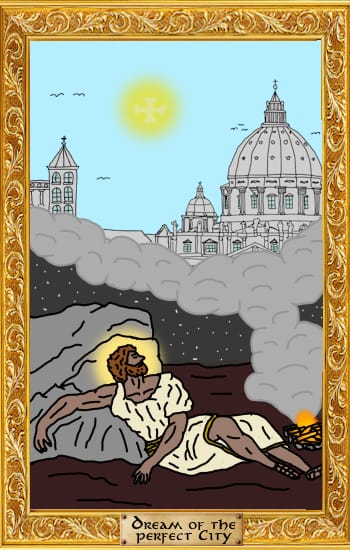
From Chapter XI:
the work depicts an ideal city, perfect, where everyone lived in fabulous harmony. The balance was so solid that nothing could break it, not even the arrival of a stranger, as Aristotle was in his imagination.
ITA
Dal Capitolo XI:
l'opera raffigura una città ideale, perfetta, dove tutti vivevano in una favolosa armonia. L’equilibrio era così solido che nulla avrebbe potuto romperlo, neppure l’arrivo di uno straniero, come lo era Aristotele nella sua immaginazione.
_________________
figlia di Callez e Betelgeuse, sorella di Edoard1, Jacklionheart, Margot_isabelle e Sarkhan_
Dernière édition par katnis. le Jeu Jan 29, 2026 9:38 pm; édité 1 fois |
|
| Revenir en haut de page |
|
|
Sarkhan_
Inscrit le: 19 Juin 2021
Messages: 18
|
| Posté le: Jeu Jan 29, 2026 9:21 pm Sujet du message: |
|
|
12. Artist Unknown (Tuscan School)

The Hermit
Aristotle was walking in Attica because he had visited a distant relative who lived in Thebes.
He was all alone, he came to a fork in the road,
he took the wrong direction, and instead of turning back, he continued
on his way.
After two hours of walking, he spotted an isolated house. He approached, knocked on the door, and an old man opened it.
It was the hermit, dressed in rags and very thin.
They sat down and began to talk.
Aristotle: "Good morning, old man. I'm lost and looking for the road to Megara."
Hermit: "If you go there, you'll be lost."
Aristotle: "I don't recall the city or the surrounding roads being inhabited by bandits."
Hermit: "Who said anything about bandits? They're populated by humans. It's dangerous enough."
Ita
Opera realizzata dagli Artisti della Scuola Toscana
L'eremita
Aristotele camminava in Attica poiché aveva fatto visita ad un lontano parente che viveva a Tebe.
Era tutto solo arrivò ad una biforcazione ,
sbagliò la direzione e invece di torare indietro continuò
il suo cammino.
Dopo due ore di marcia scorse un abitazione isolata si avvicinò ,bussò alla porta gli venne ad aprire un vecchio
era L'eremita vestito di stracci ed era molto magro
Si sedettero e incominciarono a parlare
Aristotele: "Buongiorno, vecchio uomo. Mi sono perso e cerco il cammino di Megara."
Eremita: "E’ se ci vai, che sarai perduto."
Aristotele: "Non ricordo affatto che la città o le strade nei dintorni siano popolate di briganti."
Eremita: "Chi dunque ha parlato di briganti? Sono popolate di umani. È già abbastanza pericoloso.”
_________________
|
|
| Revenir en haut de page |
|
|
katnis.
Inscrit le: 15 Juin 2020
Messages: 23
|
| Posté le: Ven Jan 30, 2026 7:27 pm Sujet du message: |
|
|
13. "Aristotle Teaching Alexander" by Father Julian from Denia
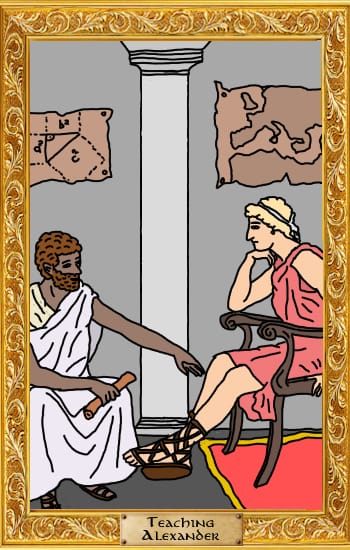
The work depicts Aristotle as a teacher to Emperor Alexander.
ITA
L'opera raffigura che Aristotele fa da maestro all'Imperatore Alexander.
_________________
figlia di Callez e Betelgeuse, sorella di Edoard1, Jacklionheart, Margot_isabelle e Sarkhan_ |
|
| Revenir en haut de page |
|
|
Sarkhan_
Inscrit le: 19 Juin 2021
Messages: 18
|
| Posté le: Ven Jan 30, 2026 8:20 pm Sujet du message: |
|
|
14."Aristotle’s Ideal and Perfect Aornos"by Wedzimir Lubomirski

In this painting, artist Wedzimir Lubomirski
depicts Aristotle arriving in Athens to meet Professor Plato..
Ita
L'artista Wedzimir Lubomirski in questo dipinto
raffigura Aristotele che raggiunse Atene per incontrare il Professore Platone
_________________
|
|
| Revenir en haut de page |
|
|
|
|
Vous ne pouvez pas poster de nouveaux sujets dans ce forum
Vous ne pouvez pas répondre aux sujets dans ce forum
Vous ne pouvez pas éditer vos messages dans ce forum
Vous ne pouvez pas supprimer vos messages dans ce forum
Vous ne pouvez pas voter dans les sondages de ce forum
|
|
 FAQ
FAQ Rechercher
 Liste des Membres
 Groupes d'utilisateurs
 S'enregistrer
 Profil
 Se connecter pour vérifier ses messages privés
 Connexion