 |
L'Eglise Aristotelicienne Romaine The Roman and Aristotelic Church
Forum RP de l'Eglise Aristotelicienne du jeu en ligne RR
Forum RP for the Aristotelic Church of the RK online game
 
|
| Voir le sujet précédent :: Voir le sujet suivant |
| Auteur |
Message |
Ferecide

Inscrit le: 02 Mai 2016
Messages: 186
Localisation: Lodi - Episcopium/ Rome - Villa Lante
|
 Posté le: Dim Déc 28, 2025 7:27 pm Sujet du message: Hall of the Prophets-Sala dei Profeti-Salle de Prophètes Posté le: Dim Déc 28, 2025 7:27 pm Sujet du message: Hall of the Prophets-Sala dei Profeti-Salle de Prophètes |
 |
|
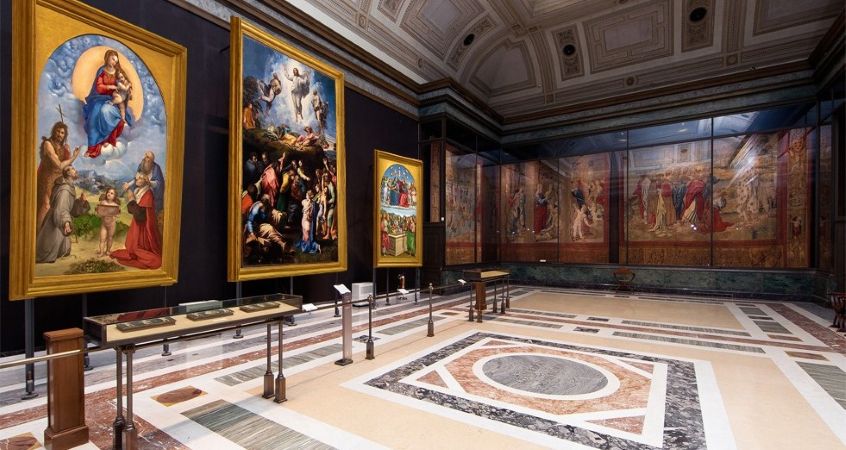
The Hall of the Prophets is the section of the Museums dedicated to collecting and showing the world the works of art representing the lives and legacies of the Two Prophets. The sunlight filtering through the windows gives this Hall a supernatural lighting, the marble and precious golden frames of the paintings reflect that sunlight even in the darkest corners. Every faithful should visit this Hall at least once in a lifetime, to live and experience a deep spiritual contemplative moment.
_________________
 |
|
| Revenir en haut de page |
|
 |
Ferecide
Inscrit le: 02 Mai 2016
Messages: 186
Localisation: Lodi - Episcopium/ Rome - Villa Lante
|
| Posté le: Mar Fév 03, 2026 5:23 pm Sujet du message: |
|
|
1. "Birth of Aristotle" by Father Julian from Denia
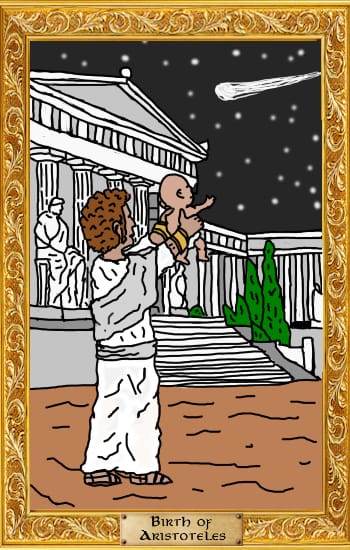
The first painting made by the artist Father Julian from Denia represents the birth is depicted when the father shows him in his arms by raising him.
2."The Revelation" by Father Julian
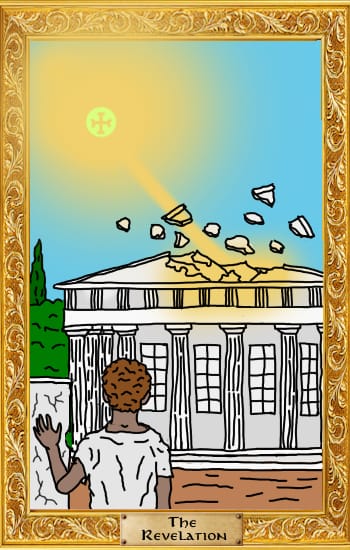
The work by the artist Father Julian depicts The Revelation
In which Aristotle receives the Word of the Creator.
One day, the young Aristotle, when he was only five years old, wanted to sit near the temple of the false god Apollo in the city of Stagira.
The child loved to gaze at the tall white stone columns standing out against the blue sky. As he approached the temple steps, he stopped, as if immobilized by an invisible force.
Not understanding what was happening, he turned toward the city to call his mother, Phaestis, who was nearby. But no sound came from his lips.
3. "The Soul" by Mons. Branwyn Von Hohenzollern Habsburg

The spectacle of the soul
The inner revelation
"Know thyself, and thou shalt know the Creator."
(Book of Virtues, Dialogues of Aristotle)
Aristotle sits alone, immersed in divine light.
A ray from above pierces the darkness – a symbol of knowledge
that does not come from man himself, but is bestowed by the Most High.
The book before him represents dogma, the scripture of truth,
while the angels in the golden haze embody divine inspiration.
This scene depicts the silent birth of philosophy in the heart of the prophet:
he recognises that the soul is a divine spark
that returns to the Creator through knowledge and virtue.
The work of the artist Monsignor Branwyn Von Hohenzollern Habsburg depicts The Soul
In which Aristotle establishes that man must have a mind, as opposed to animals.
4. Artist Unknown (Tuscan School)
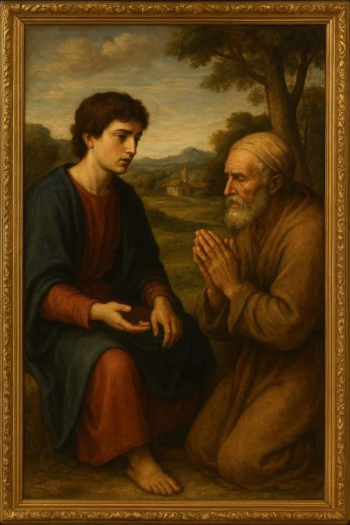
The Wandering Days
These unknown artists of the Tuscan school depict Aristotle
at the age of fifteen, lost both his father and mother, and was entrusted to the guardianship of a close relative, Proxenus,
who lived in a remote region between Stagira and Athens. The young orphan was raised to work the land. This condition did not satisfy him at all,
convinced as he was that his mind was more skilled than his hands. He often met humble peasants, with whom Proxenus worked. He certainly admired their love for the simple life.
5. Artist S.E. Branwyn von Hohenzollern-Habsburg

"Aristotle teaches the humble"
Knowledge as a divine gift
‘Those who seek wisdom must first learn humility.’
(Book of Virtues, Logion of Aristotle)
Aristotle, the first prophet, teaches the truth of God.
A man kneels before him – a symbol of man who receives knowledge
not through pride, but through humility.
His raised hand is a sign of the divine word,
his gaze rests gently on the learner.
The landscape opens up in peace and harmony,
a sign of the balance of virtues.
Red stands for divine love, blue for heavenly reason.
Those who find the centre recognise the divine mirror within themselves..
Another painting made by the artist H.E. Branwyn von Hohenzollern-Habsburg
In this painting she represents Aristotle, who teaches the humble the truth of God.
6."Aristotle in the Academy of Athens"

The artist Maeli depicts in the painting
Aristotle advancing into the Academy of Athens after his long journey. He wears sober, austere clothing,
reminiscent of a man dedicated to the spiritual life.
His bearing is composed, and his face, serene yet alert, reflects his habit of meditation and inner discipline.
The setting is a grandiose marble building:
colonnades, soaring arches, and solemn statues frame the scene, creating an almost sacred atmosphere.
In the center, Aristotle meets Plato, who observes him with interest as the young man presents a rigorous argument,
composed of clear and compelling logical steps.
The intensity of the hand gestures suggests a syllogism taking shape, so clear that it strikes the master himself.
Around the two, groups of scholars converse lively,
but the light falling on the protagonists isolates the meeting
as a significant moment,
a passage of knowledge and dedication.
The whole creates a scene in which spirituality
and reason intertwine,
showing an Aristotle who brings to the heart of the great Academy an almost monastic rigor combined with a prodigious mind.
_________________
|
|
| Revenir en haut de page |
|
|
|
|
Vous ne pouvez pas poster de nouveaux sujets dans ce forum
Vous ne pouvez pas répondre aux sujets dans ce forum
Vous ne pouvez pas éditer vos messages dans ce forum
Vous ne pouvez pas supprimer vos messages dans ce forum
Vous ne pouvez pas voter dans les sondages de ce forum
|
|
 FAQ
FAQ Rechercher
 Liste des Membres
 Groupes d'utilisateurs
 S'enregistrer
 Profil
 Se connecter pour vérifier ses messages privés
 Connexion


